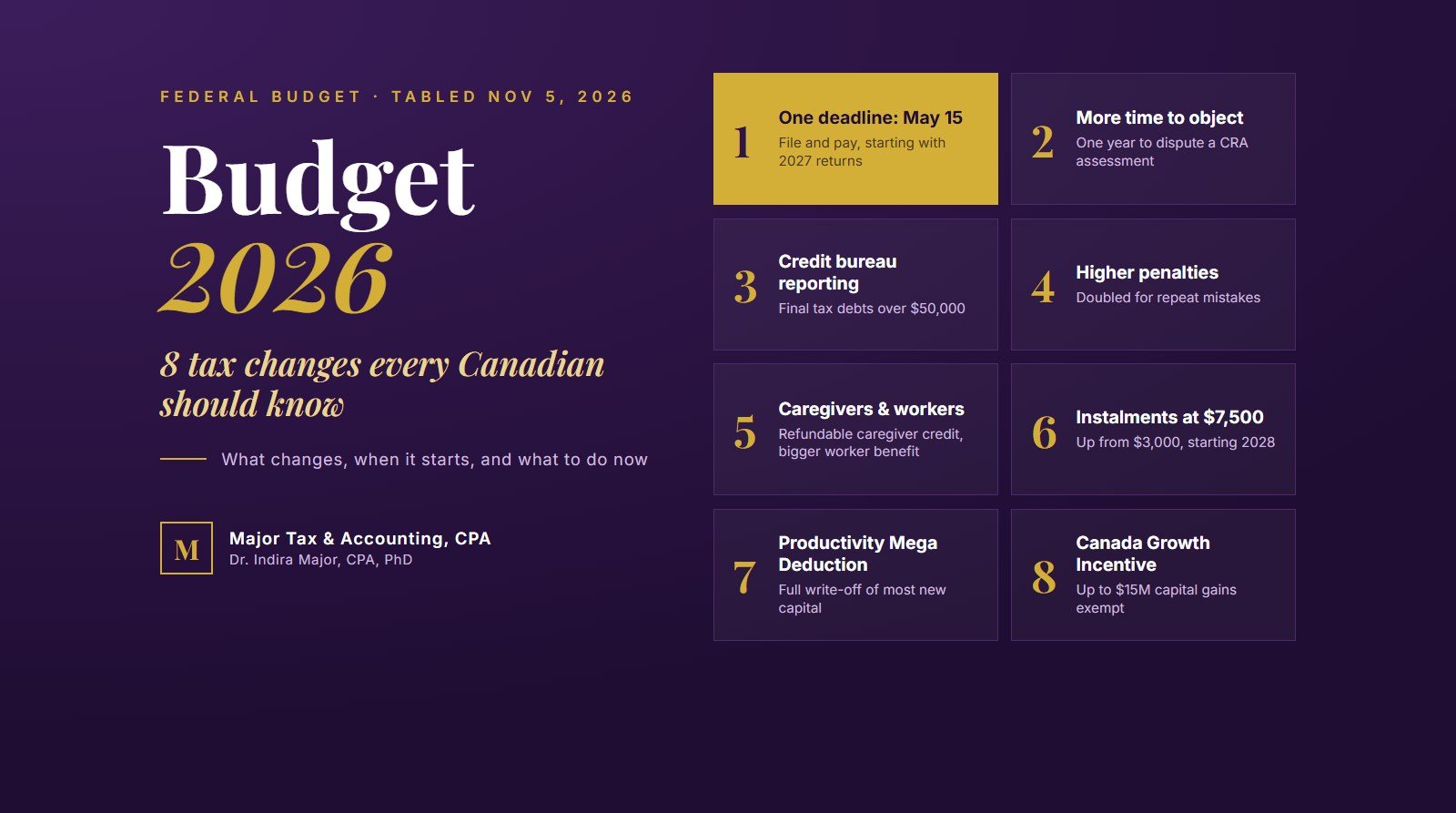
Budget 2026: 8 Tax Changes Every Canadian Should Know
The federal government tabled Budget 2026 on November 5, 2026. Budgets can feel like a wall of numbers, so I read through it for you. The good news? Many of these changes make your taxes simpler, and some put more money back in your pocket.
One thing to keep in mind before we start. A budget is a plan. These changes are proposals, and they only become law once Parliament passes them. Still, when you know early, you can plan early. Here are the eight changes I think every Canadian should know about.
1. One tax deadline for everyone: May 15
Right now, most people must file their personal tax return and pay any balance owing by April 30. If you are self employed, you can file by June 15, but your balance is still due April 30. That split catches a lot of people, and they end up paying interest.
Budget 2026 proposes one date for everyone: May 15, to file and to pay. It covers employees, self employed people, and their spouses or common law partners. If you are self employed, your filing date moves earlier, from June 15 to May 15, but your payment date moves later, from April 30 to May 15.
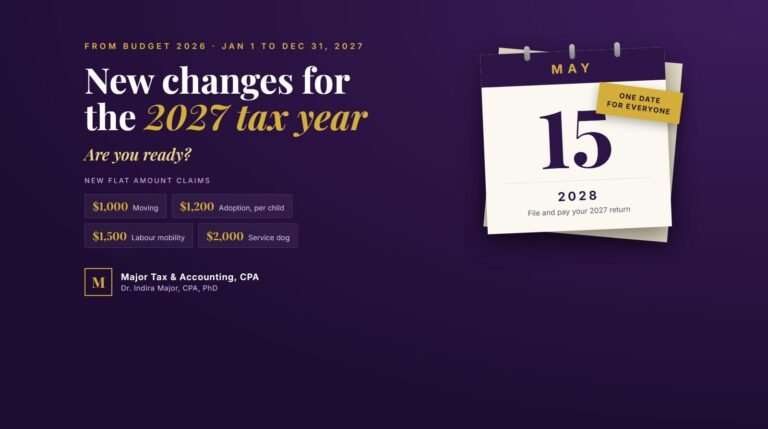
Here is the key detail. This starts with the 2027 tax year, so your first May 15 deadline is in 2028. For the return you file next spring, the old dates still apply. The government expects this change to save Canadians about $230 million in interest and penalties over five years.
2. More time to dispute a CRA bill
When the CRA sends you a notice of assessment you disagree with, you can file a notice of objection. That is the formal way to say, “I disagree. Please take another look.”
Today, you generally have 90 days from the date the CRA sends the assessment. Individuals get the later of those 90 days or one year after the filing due date, and you can ask for an extension if you miss it.
The budget proposes more time. Most taxpayers would get one year from the date the assessment is sent. Individuals and graduated rate estates would get the later of that one year or two years after the filing due date. The catch is that extension requests go away. The new deadline is a hard deadline. This would apply to assessments sent three months or more after the law passes.
My advice: do not treat the extra time as a reason to wait. Open your mail, read every notice, and call your accountant right away if something looks wrong.
3. Large tax debts could be shared with credit bureaus
This is the change people are talking about. The budget proposes to let the CRA share large tax debts with credit bureaus, the companies that keep your credit report. Lenders check that report before approving a mortgage, a car loan or a credit card.
There are clear limits:
- The debt must be more than $50,000.
- It only applies once you can no longer object or appeal. If you are still disputing the bill, it cannot be shared.
- The CRA must give you at least 30 days written notice first, make reasonable efforts to collect, and give you a chance to set up a payment arrangement.
- It covers income tax debts and GST/HST debts, and would start once the law passes.
Most Canadians will never come close to this. If you do owe a large amount, you have options. Contact the CRA early and ask for a payment arrangement. A plan on paper protects you far better than silence.
4. Higher penalties, especially for repeat mistakes
Many CRA penalties are fixed dollar amounts that have not changed in years. The budget proposes to raise most of them to catch up with inflation. Older penalties would go up two or three times, and then rise with inflation every five years.
Repeat mistakes would cost more. Penalties would generally double if you made the same kind of mistake in any of the three prior years and did not fix it after the CRA asked. Medium sized corporations and partnerships would face three times the base penalty, and large ones eight times. These changes would apply to tax years ending after 2027. The lesson is simple: file every form on time and fix problems the first time the CRA asks.
5. More help for caregivers and workers
The Canada Caregiver Credit becomes refundable starting with the 2027 tax year. Refundable means you can receive the money even if you owe no tax at all. For 2027, it is worth up to $1,260 for some caregivers.
The Canada Workers Benefit gets a new name: the Build Canada Workers Benefit. For 2027, the maximum rises to $1,859 for a single person and $3,143 for a family. You start to qualify once you earn just $500 from work, down from $3,000. Advance payments drop to 25% in 2027 and end in 2028, so more of the benefit will come at tax time.
There is no new personal income tax rate cut in this budget. The lowest federal rate has already dropped to 14%, and the budget notes this saves a two income family up to $840 this year.
6. Fewer people paying instalments
Instalments are tax payments you make during the year so you do not face a big bill at tax time. Today, you must pay them if you owe more than $3,000, a limit that has not changed since 2008.
The budget raises the threshold to $7,500 and indexes it to inflation. For Quebec residents, the federal limit goes from $1,800 to $4,500. It applies to individuals and corporations for tax years beginning on or after January 1, 2028. About 1.1 million people are expected to stop paying instalments. Self employed individuals would make one instalment payment a year, equal to two thirds of their tax, due December 31.
7. The Productivity Mega Deduction for businesses
If you own a business, this one matters. The Productivity Mega Deduction lets businesses write off the full cost of most new capital investments in the year they start using them. The government says about two thirds of capital assets will qualify, up from about 15% before. It applies to investments acquired on or after September 15, 2026, and it is permanent. If you are planning to buy equipment, talk to your accountant about timing.
8. The Canada Growth Incentive and more time to reinvest
The Canada Growth Incentive would let individuals exempt up to $15 million of capital gains per business on qualifying shares of Canadian businesses issued on or after budget day and before 2037. The detailed rules are still to come.
The budget also gives you more time to reinvest when you sell eligible small business shares. You would have the year of the sale plus three more calendar years to buy new shares. That starts with sales on or after January 1, 2027.
What business owners should do now
- Plan major equipment purchases with the Productivity Mega Deduction in mind.
- Clean up any late or missing filings now, before the higher penalties start.
- Watch for the new instalment threshold in 2028. Your corporation may no longer need to pay instalments.
- If you have any tax debt, set up a payment arrangement before it grows.
Watch the video
I walk through all eight changes in my YouTube video, Budget 2026: 8 Tax Changes Every Canadian Must Know. Many of these changes start in the 2027 tax year, so read my next article, New Changes for the 2027 Tax Year: Are You Ready?
We show up for our clients
Whether you are an individual, a family or an incorporated business owner, our team can help you plan for these changes. Book a consultation with Major Tax & Accounting, CPA at www.majortaxaccounting.ca.
This article is for general information only and is not tax, legal or financial advice. Budget measures are proposals until Parliament passes them, and the final rules may change. Speak with a professional about your own situation.